


A recent IBM study states that nearly three-quarters of customers still rely on in-store shopping. However, only 9% of them are truly satisfied with their shopping experience.
Most retailers, in fact, do not know their customers as well as they think. In the worse case, they assume their customers are “everyone”; in the better case, they primarily understand them through demographic indicators.
But demographics only tell us who the customer is on paper. They do not tell us how they think about purchasing, what drives their decisions, why they came to the store instead of shopping online, or what they expect from the visit.
And yet, that is what really matters. Let’s illustrate this with three demographically identical women visiting a bookstore.
One comes to see a book she discovered online. She needs to quickly orient herself in the store and find the book so she can browse it and confirm her choice. The second customer is looking for a gift in a genre she does not understand and needs expert staff advice. The third is an avid reader who has come to see what’s new – she is looking for a strong book selection and a pleasant environment.
Three demographically identical customers, three completely different expectations of the same space, merchandising, and interaction with staff. What ultimately convinces each of them to buy depends on the reason for their visit, not their age or marital status.
And this is where the most common misunderstanding of customer experience lies: it is not about store refits, gifts, or digital gimmicks for effect. It is about consciously and precisely addressing why the customer actually came into the store. When a brand does not understand these reasons, it cannot properly design merchandising or service accordingly.
What differentiates Martinus on the Czech-Slovak market is precisely its deep understanding of customers. In our latest collaboration, we focused on a large group of so-called undecided customers who enter bookstores without a clear intention to buy.
The goal was to design a system that helps undecided customers more easily find a book that interests them, while also making better use of staff time and operational capacity.
The result is an increase in conversion of merchandising displays among undecided customers and a 75% reduction in the cost of creating them.
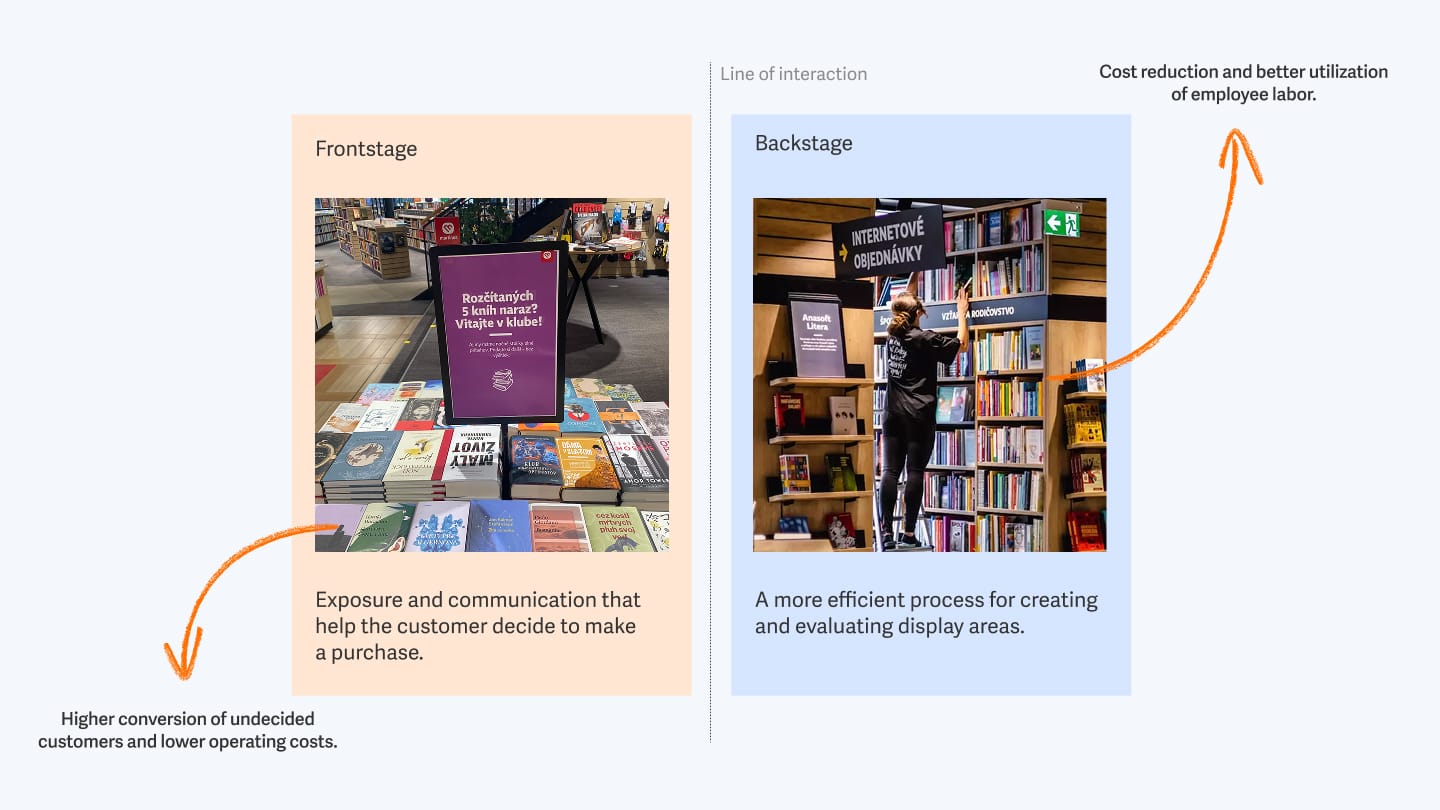
Customer interviews revealed why people leave without a book
Together with Martinus, we approached the problem in an agile and systematic way – through a series of design sprints based on research, experimentation, and rapid in-store testing.
Every undecided customer represents an opportunity to connect them with a book that captures their interest and further develops their reading habits and reader identity.
To understand what most influences this indecision, we conducted short intercept interviews directly in bookstores to quickly learn what prevents customers from choosing and what, on the contrary, helps them decide to purchase a book.
In addition to customers, we also focused on staff and how merchandising displays are created. Through in-depth interviews with employees, we mapped their current process in detail – how they think, make decisions, and what they handle when creating a new book display.
This allowed us to identify key moments that have the greatest impact on display conversion rates, such as title selection or the parameters of the communicated message.
From hypothesis to higher conversion and lower costs
Based on these insights, we created new forms of merchandising and communication, which we tested through a series of experiments in selected stores. The experiments were conducted using A/B and before/after testing, comparing differences in title sales performance. The most successful concepts were then tested across the entire network to validate their effectiveness at scale. Those that consistently delivered the best results became the new merchandising standard and were integrated into the display manual for the entire bookstore network.
This approach allowed us to identify clear, repeatable merchandising patterns that help undecided customers more easily find books they are interested in – while delivering higher conversion for Martinus and fulfilling its mission: connecting people with books.
Instead of building a complex new system, we designed a set of concrete adjustments and solutions at the most important points in the process. These were tested through a prototype tool for title selection directly with employees, refined based on their feedback, and then integrated into the existing internal system.
Internal digital assistant for creating book displays
We designed an intelligent internal tool that guides employees through a simple process so that the resulting display has the highest conversion potential. This tool, developed in-house at Martinus, recommends the most suitable titles based on real sales data, a general book score, and AI-driven recommendations for books with the highest sales potential.
New design manual for merchandising displays
Based on findings from experiments and customer interviews, we also created a data-driven manual that serves as a guide for building merchandising displays optimized for the needs and conversion of undecided customers. It includes recommended communication formats, specifications for effective posters and visuals, principles for selecting and combining titles, as well as visual aids that increase conversion.
Together with Martinus, we created a comprehensive system that enables the creation of high-converting and inspiring displays consistently, quickly, and based on data. The new merchandising system delivered measurable improvements in two areas: higher conversion of undecided customers and lower operational costs for display creation.
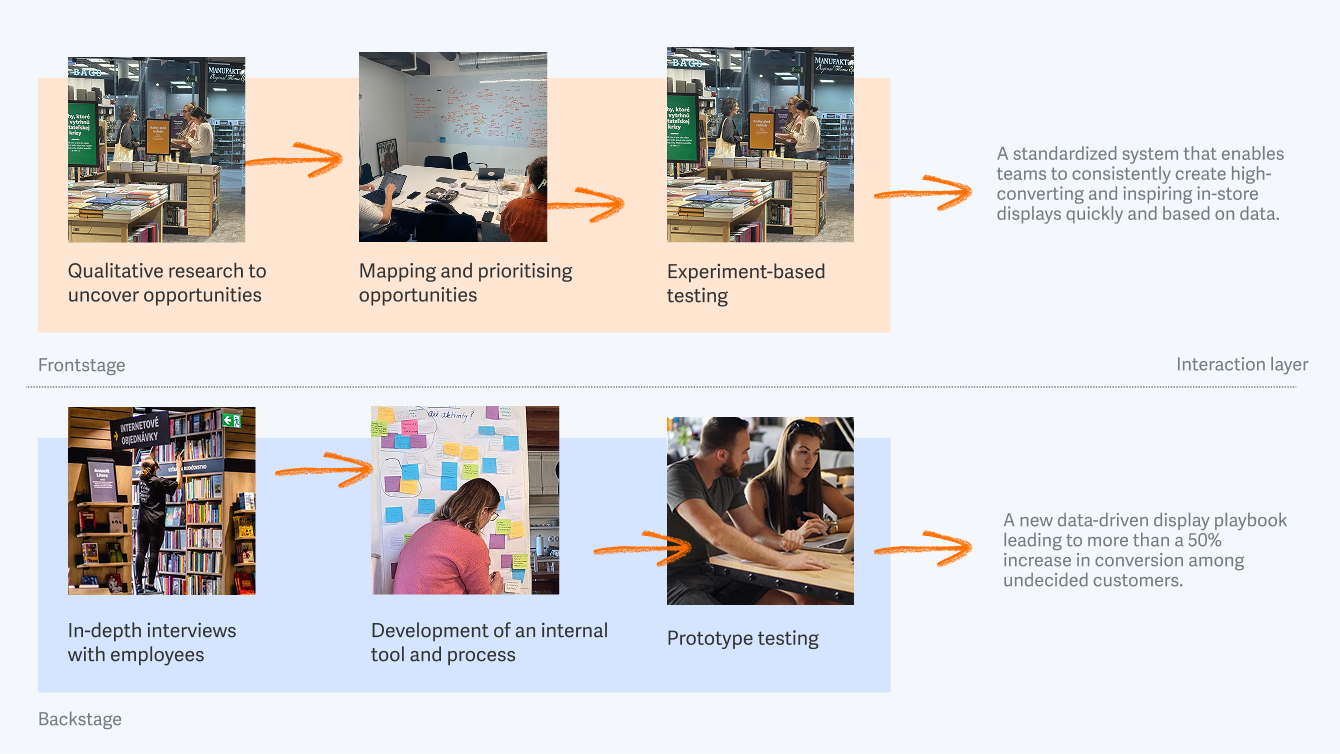
Customer experience starts with employee experience
Customer experience does not arise only in the interaction with the customer, but across the entire system that shapes their decision – from customer motivation to employee workflows. This approach shows that improving conversion is not the result of a single intervention, but of aligning customer experience and internal processes into one functional system based on a deep understanding of customer needs.
This project was not a one-off intervention. On the contrary, it helped Martinus build internal capabilities and the ability to independently repeat this approach in the future through skills in design thinking, experimentation, and data-driven merchandising...
